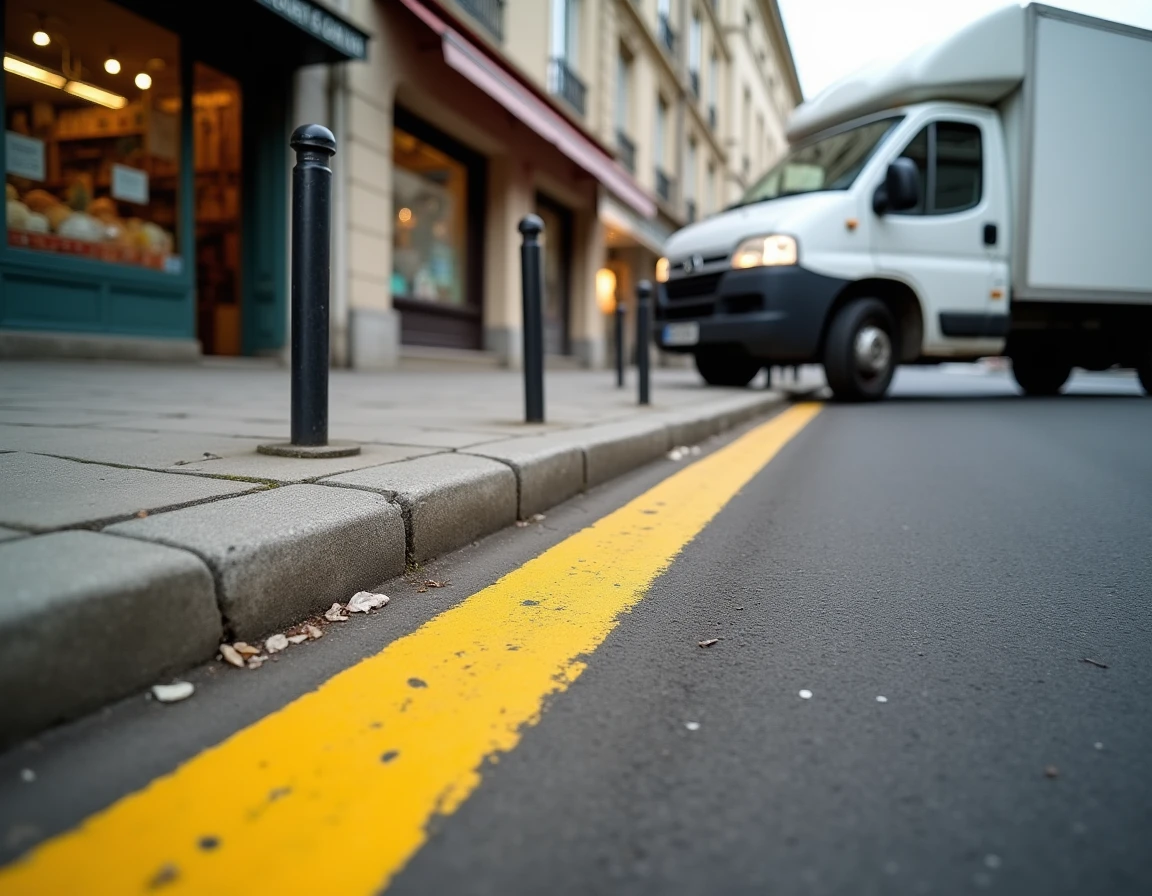
The yellow lines painted along the sidewalks are not merely a municipal aesthetic choice. They reflect specific rules from the Highway Code regarding parking and stopping, with direct consequences for drivers who ignore them. Their presence is increasing in French city centers, driven by pedestrian safety and accessibility goals that are reshaping the use of public space.
Solid or broken yellow line: what the ground really tells drivers

The distinction between a solid yellow line and a broken yellow line painted at the edge of the sidewalk does not concern parking in the broad sense, but rather the difference between parking and stopping. A solid yellow line prohibits both parking and stopping. A vehicle cannot stop along this edge, even with the engine running, even to drop off a passenger.
A broken yellow line, on the other hand, prohibits parking but allows stopping. A driver can therefore stop briefly, provided they remain close to their vehicle and do not turn off the engine for an extended period. This nuance, often misunderstood, accounts for a significant portion of fines in urban areas.
The regulation of yellow lines in parking is based on the interministerial instruction on road signage, which governs the colors and shapes of road markings. Yellow is reserved for exceptional situations compared to permanent white markings: specific prohibitions, temporary zones, or reserved spaces.
A third yellow marking exists along sidewalks: the zigzag. Marked in front of bus stops, it prohibits any parking and stopping of vehicles other than the concerned public transport. Non-compliance with this area exposes one to a fixed fine and, in some cases, towing.
Securing pedestrian crossings: yellow lines gaining ground

In recent years, French municipalities have been expanding the use of yellow markings around pedestrian crossings. The goal is to clear visibility between pedestrians and drivers by eliminating parking in areas close to crossings.
Several major cities plan to generalize these visual safety measures before the end of 2026. Specifically, yellow lines or zebras are replacing old parking spots located too close to pedestrian crossings. The maneuver is simple: by moving the first parked vehicle back a few meters, a child or a person in a wheelchair becomes visible to an approaching driver.
This trend is not solely based on municipal common sense. It is part of a broader regulatory logic that articulates horizontal signage and accessibility obligations. Field feedback varies on this point: some municipalities apply these expansions systematically, while others proceed on a case-by-case basis depending on local accident statistics.
Accessibility for people with reduced mobility and yellow markings: an increasingly stringent articulation
The link between yellow lines and accessibility for people with reduced mobility (PRM) is strengthening in parking lots as well as on the roadway. The compliance of PRM reserved spaces requires clear pathways between the parking space and access to the building or sidewalk.
Parking spaces close to access points are removed or relocated to free up these pathways, marked by yellow lines or zebras prohibiting stopping. A vehicle parked in this area blocks the passage of a wheelchair or stroller, which justifies an aggravated fine.
Obligations are not limited to private parking lots open to the public. On public roads, municipalities must ensure continuous access between PRM spaces and curb cuts. Yellow markings become the preferred tool to signify this prohibition, as they visually distinguish themselves from the white markings that delineate authorized spaces.
- Yellow zebras in front of curb cuts prevent parking in PRM passage areas
- Yellow lines along access ramps signal a permanent prohibition of stopping and parking
- Spaces marked in yellow in parking lots indicate no-parking zones (emergency exits, pathways, maneuvering areas)
Sanctions and contesting a fine related to yellow markings
Parking in an area marked in yellow exposes one to a fine of varying categories depending on the nature of the offense. Inconsiderate parking in a space reserved for buses or PRM results in a heavier fine than simply parking in a prohibited area on a broken yellow line.
Towing is possible in several scenarios:
- Vehicle parked at a bus stop (yellow zigzag marking)
- Vehicle blocking a pedestrian crossing whose clearance is marked by yellow zebras
- Vehicle occupying a PRM space without a valid parking permit
- Vehicle parked on a solid yellow line, obstructing traffic or emergency access
Contesting a ticket often hinges on the condition of the road marking. A faded or illegible marking weakens the legal basis for the fine. For a prohibition marked on the ground to be enforceable, the marking must be visible and comply with current technical standards. A fined driver can photograph the degraded state of the marking to support a contestation with the public prosecutor’s office.
However, the absence of a vertical traffic sign does not always invalidate a fine. The Highway Code provides for parking prohibitions that apply without signs or markings (in front of driveways, on bridges, in tunnels). The yellow marking serves to confirm and reinforce these prohibitions, but it is not the only legal source.
The gradual expansion of yellow markings in French cities reflects a clear trade-off between parking spaces and the safety of vulnerable users. Drivers who regularly navigate urban areas have a vested interest in precisely distinguishing the three forms of yellow marking (solid, broken, zigzag) to avoid fines whose amounts and consequences vary depending on the area concerned.