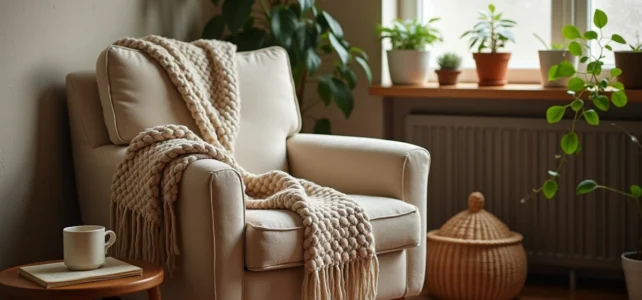
Behind the desire for a cozy interior lie technical choices related to light, finishing materials, and even the quality of the air we breathe. Several of these parameters are governed by recent regulations, notably RE2020, which change the way we can think about thermal and luminous comfort in a home.
Indoor air quality and cocooning atmosphere: an often-overlooked angle
Articles on cocooning decor readily recommend scented candles, oil diffusers, and synthetic textiles. While these elements contribute to the atmosphere, they can also degrade the air in a closed room. Ademe, in its updated 2024 guide “Indoor Air Quality,” warns against the proliferation of indoor fragrances and scented candles in living spaces.
The issue of volatile organic compounds (VOCs) in French homes remains central. The recommendation is clear: prioritize paints and coatings with very low emissions for the rooms where we spend the most time, such as the living room or bedroom.
A warm and healthy interior relies on a few reflexes:
- Ventilate each room for at least ten minutes a day, even in winter, to renew the air without losing all the heat accumulated in the walls
- Choose paints with an A+ label (lowest VOC emissions), even for a simple accent wall in a warm hue
- Limit scented candles to occasional use and prefer untreated vegetable waxes if you want to maintain that ambiance
- Opt for textiles made from natural fibers (linen, cotton, wool) rather than synthetic materials that can emit fine particles
This topic is rarely addressed in decor pages, even though it directly conditions the feeling of well-being in an enclosed space. A stuffy interior, even if beautifully decorated, will never be a true cocoon.
Additional resources on home design are regularly published on the News 21 website, with angles that intersect comfort and habitat.
Light and soft lighting: what RE2020 changes for your decor
Light is the most powerful lever for changing the atmosphere of a room. Competitors repeat this, but they never mention the regulatory framework that now influences lighting and heating choices in new or renovated homes.
The Environmental Regulation 2020, reinforced by implementing decrees published in 2023-2024, pushes households towards more energy-efficient heating and lighting solutions. LED bulbs with adjustable color temperature have become the norm. They allow for a transition from cool light during the day to a warm hue in the evening, without changing the bulb.
Layering light sources in the living room
A single ceiling light creates a flat atmosphere. For a successful cocooning effect, interior decor benefits from multiplying light points at different heights: a reading lamp near the sofa, a discreet garland along a shelf, an adjustable floor lamp in a corner.
Three light sources at varying heights are enough to transform a living room. The goal is to create soft shadow zones that give depth to the space, rather than uniform lighting.
The bedroom: priority on indirect light
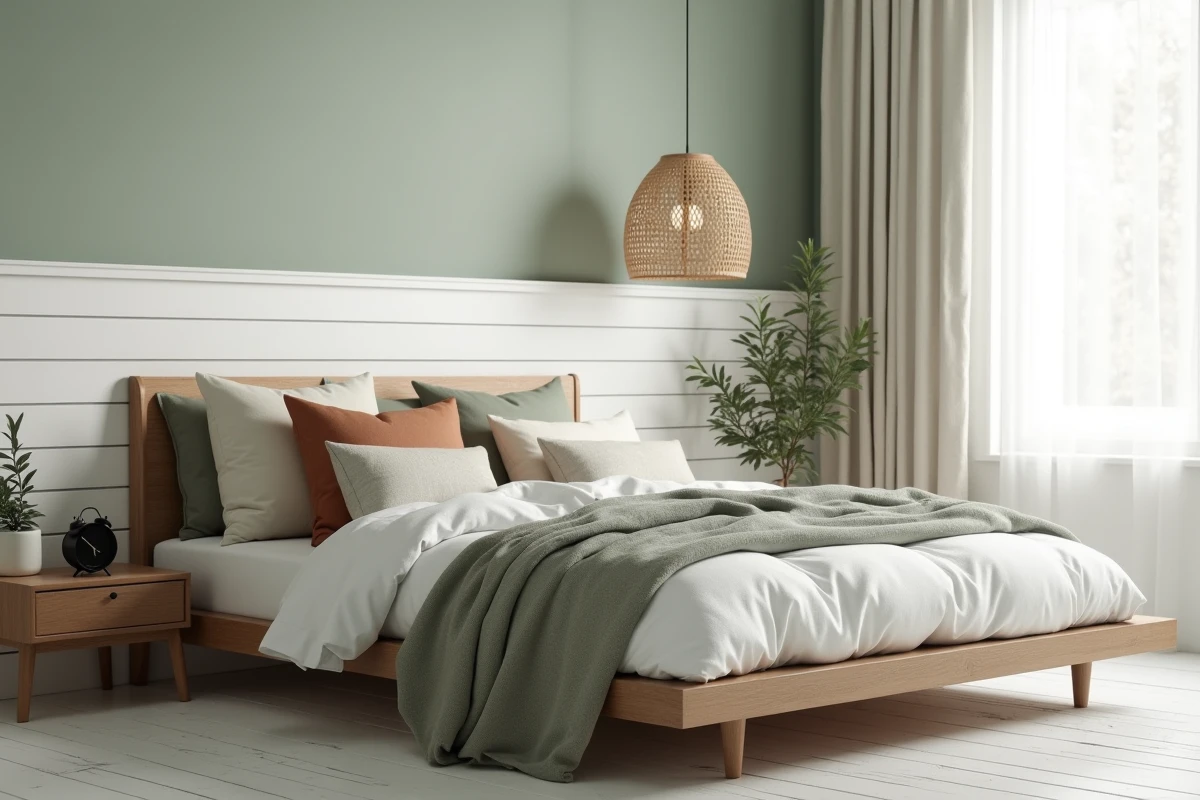
In a bedroom, direct lighting above the bed can harm sleep quality. A wall lamp directed towards the wall, combined with a small reading light, creates an enveloping atmosphere without straining the eyes. Light shades around 2700 kelvins replicate the warmth of a candle, which corresponds exactly to the cozy ambiance sought.
Materials and textiles: balancing tactile comfort and durability
The choice of materials is at the heart of any cocooning approach. Linen, velvet, boucle wool, thick cotton: each textile provides a different tactile sensation and visually alters the space.
Velvet remains the material most associated with cocooning, but it poses a maintenance issue in homes with children or pets. In contrast, washed linen, less spectacular, becomes softer over time and withstands frequent washing without losing its shape.
For the sofa, the decisive criterion is not the color but the density of the seat and the quality of the covering. A sofa with high-resilience foam retains its comfort for years, while a budget model sagging within months, regardless of the beauty of the fabric.
On the floor: natural rugs and coverings
A thick rug placed in the living room or at the foot of the bed immediately changes the thermal perception of a room. Wool or jute models provide measurable acoustic and thermal insulation, unlike thin synthetic rugs that offer only a visual effect.
The choice of flooring itself plays a role. Solid or engineered wood floors, labeled for their low VOC emissions, combine visual warmth with environmental performance. The latest generation vinyl floors also offer convincing wood imitations, but their emission ratings should be checked before installation in a bedroom.
Warm colors for a cozy space: beyond beige
Beige-cream palettes dominate online cocooning decor inspirations. They work, but they are not the only option. Terracotta, sage green, or midnight blue shades, applied to a single wall, create a focal point that visually anchors the room without darkening it.
The often-cited “60-30-10” rule (dominant, secondary, accent color) provides a useful framework. The dominant color remains neutral and light, the secondary adds warmth, and the accent (cushions, vase, frame) introduces character. This principle applies to both small spaces and large living areas.
The use of black in small touches in a cozy interior is debated among decorators. Some use it to structure the space (black frames, metallic lighting), while others find it too harsh for an enveloping ambiance. The result largely depends on the amount of natural light available in the room.
A successful cocoon relies less on an accumulation of objects than on the coherence between light, materials, and ambient air. The most effective choices are often the least visible: a healthy paint, well-positioned lighting, a textile that ages well. These technical details, more than seasonal trends, make the difference between ephemeral decoration and an interior where one feels good for the long term.