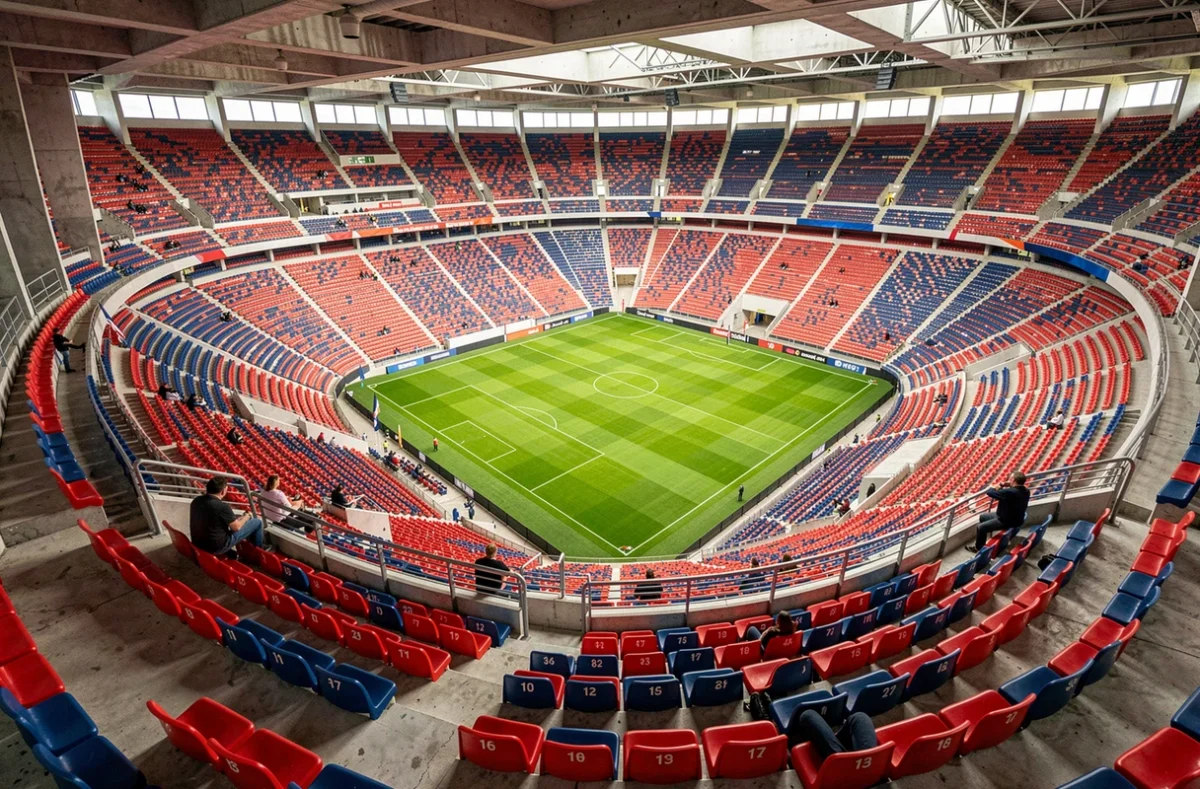
The Stade de France, located in Saint-Denis, has a capacity that varies depending on each event. A rugby match in the Nations Tournament does not offer the same number of seats as a concert with a front stage or a football final. Behind the often-cited overall figure, the reality of ticketing is influenced by multiple configurations, areas restricted by production, and categories redefined for each event.
PSH Category and Sensory Room: two distinct provisions at the Stade de France
Competitors rarely address the issue of accessibility in detail. The Stade de France offers a category dedicated to people with disabilities (PSH), which requires proof such as a mobility inclusion card (CMI) or an MDPH notification.
This category is not uniform from one event to another. PSH locations depend on the seating plan approved by the organizer. Their number, location in the stands, and pricing change depending on whether it is a football match, a rugby match, or a concert.
The Sensory Room provision addresses a different need. It is a calm and isolated space designed for spectators with specific sensory needs. The official stadium website specifies that Sensory Room seats are not suitable for people with reduced mobility.
Spectators associated with this option are seated in the stands, near the room, but it does not allow for a direct view of the arena. This is a point that the seating capacity and categories at the Stade de France help to better understand when preparing for an adapted outing.
Commercialized capacity at the Stade de France: why it differs from total capacity
The total capacity of the stadium for sports is a benchmark, not a ticketing promise. In concert configuration, several elements reduce the number of tickets available for sale.
- The stage occupies part of the stands and the pitch. A front stage (installed at one end) restricts more seats than a 360-degree stage placed in the center, but the latter redistributes the pitch space differently.
- Sound towers, giant screens, technical control rooms, and security zones eliminate entire blocks of seats.
- Some tiers may remain closed if demand does not justify the full opening of the stadium, further reducing the effective capacity.
The capacity marketed for a concert is always lower than the stadium’s maximum capacity. The gap between the two entirely depends on the production plan approved by the tour organizer. For the same artist returning two years in a row, the configuration may change.
Pricing grid and categories: nothing is fixed
The categories of seats (category 1, category 2, pitch, golden circle, VIP area) do not form a permanent grid. Each event redefines the breakdown. A category available for a match may not exist for a concert, and vice versa.
Prices are set by the organizer of each event, not by the stadium itself. Two concerts scheduled in the same week can display radically different pricing grids depending on production choices and the pricing policy of each tour.
Concert or match configuration: what changes in the stands
For a football or rugby match, the Stade de France retains its classic structure: lower tier, middle tier, upper tier, distributed on all four sides (east and west lateral, north and south corners). The pitch is the playing field, and no seats are sold there.
In a concert, the pitch becomes a spectator area. Depending on the events, it can accommodate:
- A standing pit closest to the stage, often called the golden circle.
- A seated area with numbered seats, sometimes divided into subcategories (golden pitch, standard pitch).
- A mix of the two, with a standing pit in front and a seated area behind.
The density of spectators in the standing pit is higher than in the seated area. Organizers define a ratio per square meter framed by safety standards. The last rows of the pit generally offer more space and easier access to concessions.
Seated stands in concert: visibility and comfort
The upper and middle tiers retain their numbered seats during a concert. The view is unobstructed, and some services such as ordering drinks at the seat may be available depending on the event.
However, the lower tiers located behind the stage are often restricted in front stage configuration. This significantly alters the stadium layout compared to a rugby or football match where all stands are open.
Stade de France and sporting events: seats that vary by discipline
A match in the Nations Tournament of rugby and a football league final do not utilize the stadium in the same way. The wider rugby field may slightly modify the distance between the pitch and the front rows of the lower tier.
The best seats for a football match are not the same as for rugby. In football, the lateral stands offer the best view of the game. In rugby, a quarter corner in the middle tier allows for better following of conversion and penalty phases.
For athletics competitions, the track surrounds the field and creates additional distance between spectators and the competition area. The lower tier seats then lose some of their usual proximity.
Hospitality and VIP areas
The Stade de France offers premium options (boxes, lounges, hospitality areas) whose number and location again depend on the event. These spaces are not included in the general public capacity and have their own access, services, and pricing. Their availability is managed directly by the consortium operating the stadium or by the organizer.
The distinction between general public tickets and hospitality tickets is an additional factor to consider to understand why the number of seats accessible through traditional ticketing channels remains lower than the total physical capacity of the Saint-Denis venue.