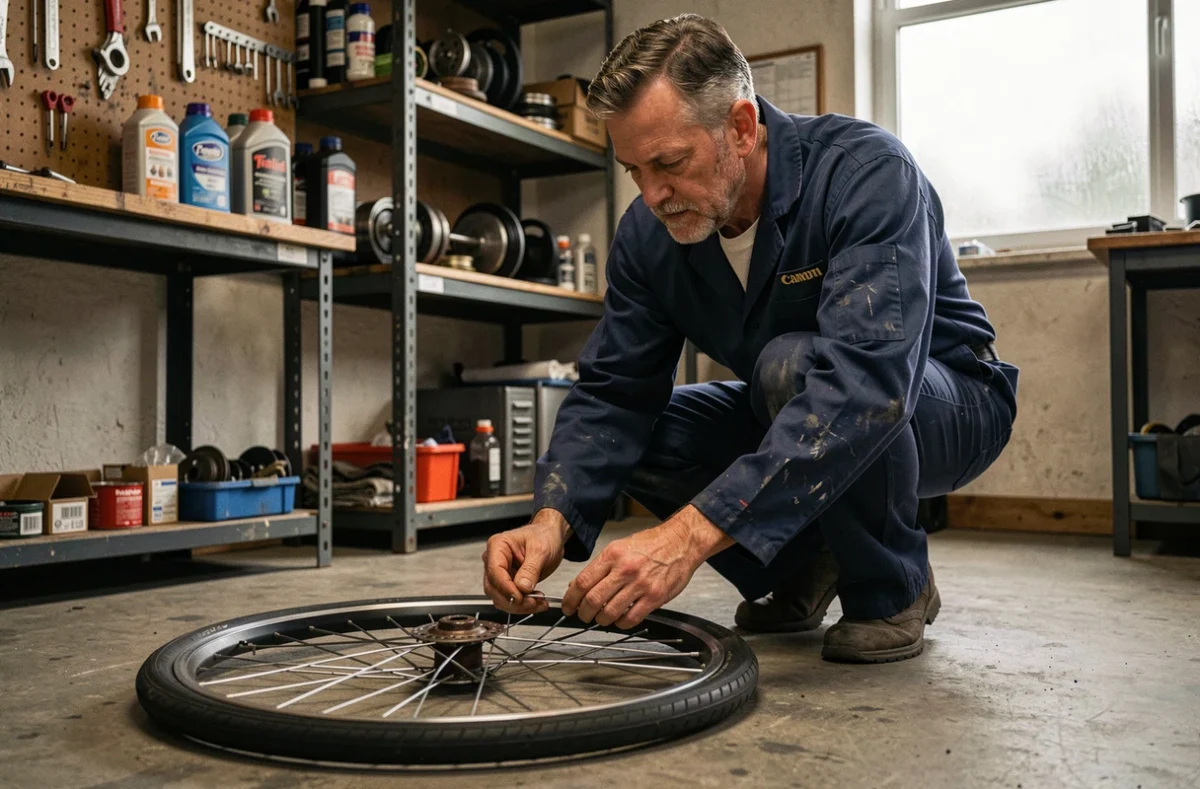
The wheel is the oldest and most fundamental component of any land vehicle. Its principle relies on the conversion of rotational motion into linear movement, a mechanism that mobilizes several parts and multiple physical forces simultaneously. Understanding how a wheel works means grasping how the engine torque travels through the transmission, reaches the hub, deforms the tire, and generates a contact force with the road.
Transmission of engine torque to the wheel
Most articles describe the wheel as a static assembly of parts. They list the rim, the tire, the hub. But the mechanics of a wheel do not start at the rim: they begin at the engine.
The torque generated by the engine first passes through the gearbox, which adjusts the ratio between engine speed and wheel rotation speed. This torque then travels through the driveshaft (or the universal joints on a front-wheel drive vehicle), and reaches the differential, which distributes the force between the two wheels on the same axle.
The differential plays an underestimated role: it allows the wheels to turn at different speeds while cornering, as the outer wheel travels a larger arc than the inner wheel. Without this mechanism, the vehicle would experience mechanical binding at every turn. The torque finally reaches the hub, the central part that secures the wheel to the axle and transmits rotation to the rim-tire assembly.
Resources like the Miss Deux Roues website detail this kinematic chain with explanatory diagrams that help visualize each step of the transmission.

Tire-road contact: where physics comes into play
The area where the tire touches the road, called the contact patch, measures only a few square centimeters per wheel. Yet it is in this small surface that all the forces that allow the vehicle to accelerate, brake, and turn are concentrated.
Friction and grip
Grip directly depends on the deformation of the tire on the ground. When the wheel turns under the effect of engine torque, the rubber of the tread deforms upon contact with the asphalt. This deformation creates a friction force that propels the vehicle forward.
If the transmitted torque exceeds the tire’s grip capacity, the wheel slips. This is the principle that triggers the intervention of traction control (ASR) or electronic stability program (ESP) in modern vehicles. The grip limit varies according to the tire compound, temperature, and road conditions.
Rolling resistance and energy loss
Each rotation of the wheel comes with an energy loss. The cyclic deformation of the tire upon contact with the ground dissipates heat, a phenomenon called hysteresis. This rolling resistance represents a significant portion of a vehicle’s fuel consumption.
European regulations are now focusing on the actual wear of the tire, not just its grip or consumption performance. Future standards aim to regulate not only rolling resistance but also the abrasion limits of tires measured under real conditions.
Wheel bearing and mechanical rotation
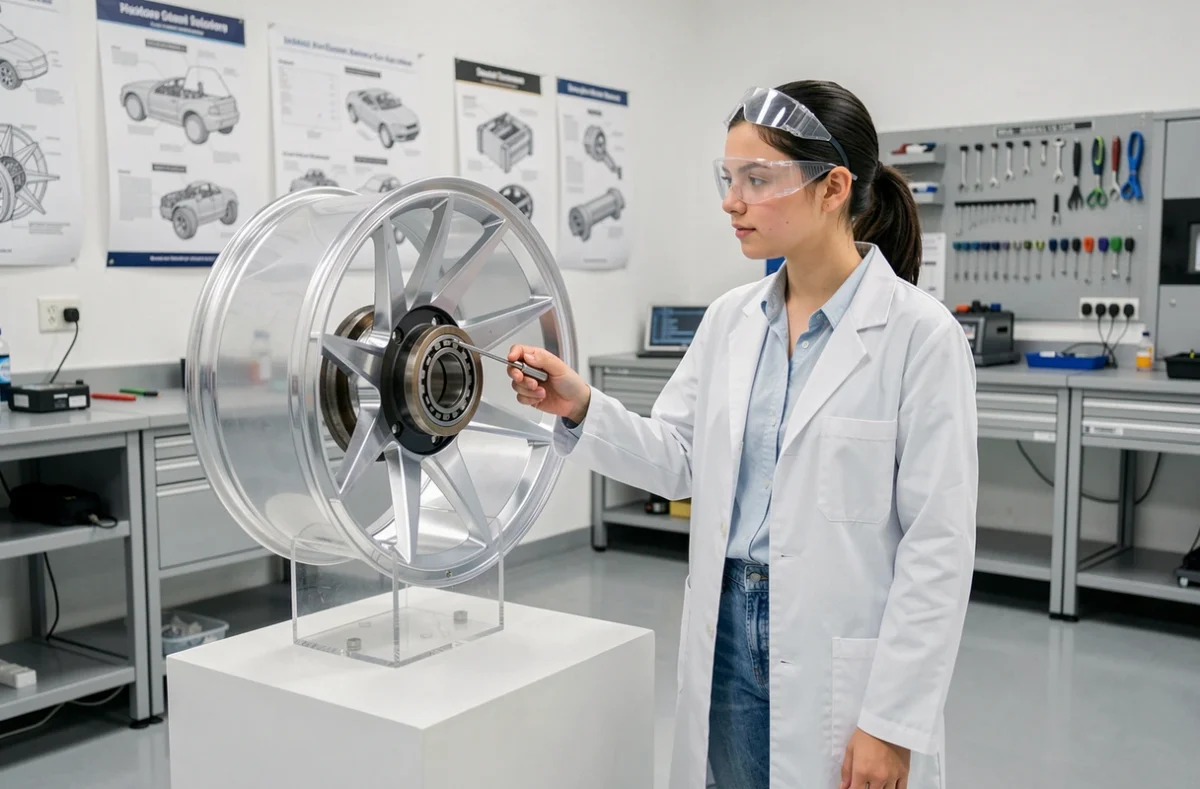
The wheel bearing is the part that allows the wheel to rotate freely around the fixed axis of the hub. It consists of an assembly of balls or tapered rollers trapped between two metal rings, all lubricated and sealed.
A worn bearing produces a dull humming that intensifies with speed. This noise often constitutes the first detectable sign for the driver. A failing bearing increases friction, generates excessive heat, and can eventually cause the wheel to lock up.
The quality of the bearing also conditions the precision of the steering. On steering wheels, excessive play in the bearing translates to a loose steering wheel and an imprecise trajectory, two symptoms that directly affect safety.
Tire pressure and onboard monitoring
The air pressure inside the tire determines the shape of the contact patch, the stiffness of the sidewall, and the ability to absorb road irregularities. An under-inflated tire flattens more, increasing rolling resistance and internal temperature. An over-inflated tire reduces the contact patch and decreases grip.
On new heavy vehicles registered in the European Union, monitoring tire pressure has been mandatory since July 2024. TPMS (Tire Pressure Monitoring System) sensors transmit pressure and temperature data in real-time, allowing maintenance based on alerts rather than just periodic checks.
For light vehicles, TPMS has been mandatory for several years. Its role remains the same: to alert the driver as soon as a wheel loses pressure abnormally, before the situation degrades road behavior.
Airless tires: a technology still in testing
Airless tires propose to eliminate the risk of punctures by replacing the air chamber with a deformable structure made of composite material or polymer. Michelin’s Uptis prototype has been tested in real conditions during road delivery operations.
No public commercialization date has been confirmed for this technology. Fleet trials are validating durability and ride comfort, but transitioning to mass production raises questions about cost, recyclability, and compatibility with existing rims.
The distinction between a technology tested in the field and a product ready for purchase remains clear. Airless tires illustrate the limits of the innovation cycle in the tire industry: prototypes roll, but public data on their long-term performance remains sparse.
The wheel remains a system where each component influences the others. A worn bearing alters the contact geometry of the tire, inappropriate pressure accelerates tread wear, and a poorly adjusted differential unevenly stresses the two wheels of an axle. Understanding these interactions means moving from a view of separate parts to a comprehensive mechanical reading of how a wheel functions.