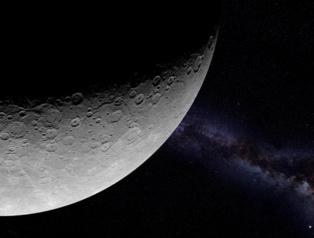
Researchers from the United States have found that Mercury’s radius has decreased by seven kilometers over the past four billion years, which is 0.8 to 3 km more than previously thought.
According to the study published in Nature Geoscience, this reduction is due to the cooling and contraction of the planet, which in turn causes the appearance of faults and lobate ridges in its crust.
“Mercury loses heat into space. This cooling of its liquid core leads to a reduction in its volume, just as it is easier to remove a ring from a cold finger than from a warm finger,” explains Sinn Paul K. Byrne, the lead author of the study and a scientist at the Carnegie Institution of Science (Washington, D.C., United States).
“Since the surface of this planet is not divided into tectonic plates like Earth, the only way to respond to this cooling is to push parts of its crust,” adds Byrne.
Until now, scientists had relied on observations made in 1975 by the Mariner 10 space mission. At that time, the probe photographed 45% of Mercury’s surface and determined its volcanic origin. Additionally, due to its relief, it was confirmed for the first time that the planet’s radius had decreased over the past millions of years.
The new study used data from the Messenger probe, which orbited Mercury in 2011, to verify that its surface has more capacity for contraction than previously thought. “For the first time, we were able to observe the other half of the planet, this time with much higher resolution thanks to a laser altimeter that measures its topographic profile,” explains William B. McKinnon, a researcher at the University of Washington.
19th Century Ancient Theory
The latest observations have allowed for the recognition of two main types of tectonic structures on Mercury’s surface: lobate scarps—a type of reverse fault—and wrinkle ridges.
Images show that there are more ridges than scarps, which are larger and found on older terrain. On the other hand, the ridges are shorter and smaller and are located almost exclusively in young volcanic areas.
According to the authors, these results provide a new global framework for research on the surface and interior of Mercury. “If the contraction continues, it is likely that the structures we have seen will continue to develop, so they will grow over time. We still do not know whether the rate at which the planet is shrinking will remain the same, slow down, or if it has already done so,” explains Byrne.
The contraction observed on Mercury’s surface has once again highlighted a 19th-century theory that posited the same for Earth. One day, this hypothesis was ruled out in the case of our planet, as it is divided into plates that prevent this phenomenon. Instead, Mercury is enclosed by a single plate.
“If Mercury had tectonic plates like Earth, contractions would have occurred at their boundaries—like in the Andes or Indonesia—rather than forming lobate scarps and ridges,” explains Byrne.
“What is not clear is whether, with more tectonic plates, this planet would have shrunk. For this process to occur, it is necessary for the core to generate heat into space,” continues the researcher. It is possible that the generation of heat necessary for plate movement has reduced the temperature that is released into space. In other words, global contraction and plate tectonics do not work together.”
Bibliographic Reference:
Paul K. Byrne, Christian Klimczak, A.M. Celâl Şengör, Sean C. Solomon, Thomas R. Watters, and Steven A. Hauck: The global contraction of Mercury is much greater than previous estimates. Nature Geoscience (2014). DOI:10.1038/NGEO2097.
Tag : Christian Klimczak