With the start of a new lockdown, since Friday, October 30, universities no longer hold face-to-face classes for students. Only libraries and university buildings remain open. In this almost empty setting, maintenance workers at these locations continue to work. For the majority of employees through subcontractors, they feel they have been left out in the cold. Forced to exercise caution against contamination since the beginning of the school year, their work has yet to be reassessed and their situation remains invisible.
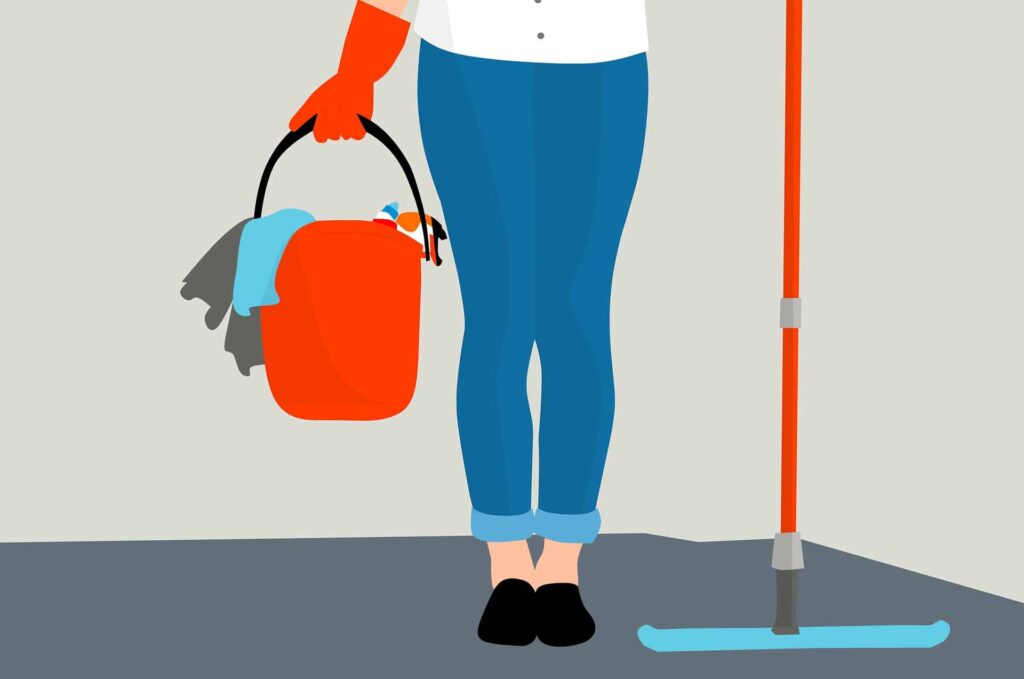
Since the 1980s, a cleaning market has developed in France and continues to grow with a trend towards outsourcing. Although cleaning is a low-skilled activity, maintenance jobs are increasingly subject to strong competition due to the proliferation of specialized subcontractors. With the tightening of technical cleaning standards, companies have diversified and specialized their activities. The market represents over 16 billion euros in France and employs more than 500,000 people. Following the general trend, universities are turning to subcontractors, such as Cervin Cleaning for the Universities of Lyon. The use of these companies through tenders allows universities to avoid directly hiring staff, which leads to budget savings.
An exacerbated situation in an ultra-competitive environment
The boom in the industry hides a more precarious reality for employees, with unfavorable working conditions. Thus, the relationship becomes triangular between universities, subcontractors, and their employees, with a contractual obligation for them in terms of results. This outsourcing is to the detriment of employees who lose their protective status (paid leave, access to mutual employment, job stability).
In particular, cleaning companies resort to abusive part-time work and force employees to move to different locations (one-third of sector employees work for multiple companies at once, and half juggle two jobs). With the outsourcing system, maintenance agents follow each other at the same site. This reinforces their isolation and the difficulty of organizing collectively to value their work. Yet, with an average gross salary of around 1,600 euros per month, many maintenance workers face economic difficulties.
The high proportion of women in the sector, often over 45 years old, increases the social fragility of employees in the sector. Saphia Doumenc, a doctoral student on the issue of unionism in the cleaning sector at the Triangle laboratory (CNRS), explains to LVSL: “80% of part-time jobs are held by women. These are often women caught in rather precarious living situations; they cannot afford to be laid off. They really live in monthly urgency. And it’s also a very interchangeable workforce.”
In the face of this, subcontracting companies in the sector do not hesitate to use pressure tactics to deter any claims, as indicated by the doctoral student:
“These are rather fraudulent practices by the employer; if there is a concern regarding the employee, they can be dismissed very quickly without worries. For example, by resorting to false letters of testimony from colleagues, which serve as grounds for dismissal for misconduct.
In this regard, the CNT-SO union emphasizes to LVSL that there has been a marked increase in layoffs in the cleaning sector in Lyon since the beginning of the coronavirus epidemic: “Many economic layoffs are disguised by a multiplication of micro-complaints in one go to be able to compile files, in order to dismiss people for serious misconduct.”
Since the start of school, additional pressure at work
From the beginning of the school year, the coronavirus epidemic forced universities to develop, or rather to cobble together, protocols and what are termed hybrid teachings, combining remote classes and face-to-face classes. On campuses, the distribution of washable masks, physical distancing measures, and the availability of hand sanitizer were indeed the only measures they could take.
In Lyon, the introduction of these new protocols required by the government is not enough to reassure maintenance workers, who number between 80 and 100 on each campus. It is the contracting companies that provide equipment to the agents, based on ministerial recommendations, but without instructions from the universities. Louise*, in her forties, has worked at the University of Lyon III since 2010. She testifies: “We have new products specifically for disinfection, also hand gel; we wash our hands, we have everything, but we are scared.” Isadora*, who works on the docks at the University of Lyon II, adds: “The new products reassure me a bit, knowing they are against the coronavirus. It reassures us to have the blouses, the caps, the disinfectant products, but I really pay attention to door handles, and sometimes when I get home, with all the tables, the people passing by, it gives me palpitations; it’s scary.” The position of maintenance agent was already one of the most exposed to physical risks before the pandemic, including infectious risks. According to the Ministry of Labor, nine out of ten employees are at risk in their workplace.
Alongside this, the situation is sometimes psychologically difficult. On the ground, the feeling of being neglected is overwhelming. These collaborators particularly regret the lack of oversight of their personal situation, as Isadora* states: “We are too scared; I am too scared. When I get home, I always think about it because I have my husband who is very sick, very fragile. He is diabetic, paralyzed after a stroke. For 4 months, I hadn’t worked; the doctor here and his doctor had given us two certificates so that I stopped working. I would like to have the opportunity to retire because I am starting to be afraid. For me already.” The question of whether the right to withdraw from work exists for maintenance agents, allowing them to refuse to work if the work environment presents a risk or a lack of protection for the employee, is actually difficult to obtain. Pierre, a union developer at the Lyon branch of the CNT-SO union, to which some maintenance agents at the University of Lyon I are affiliated, explains: “These are sick leave procedures managed by the CPAM (CPAM), but that’s the problem; the CPAM has a specific contact case view. If the person works while being protected, they are not considered a contact.”
Yet, the risk of contamination is also a daily fear for maintenance workers at the university. This represents an additional mental burden outside the workplace once I get home, as Isadora* says: “I try to make arrangements at home to prevent my husband from getting it. It’s my children who help him because I work; I can’t.”
Beyond the risk of contamination, the closure of universities also presents the risk of site transfer for some maintenance agents hired by subcontractors. A situation more than precarious that deserves to question the increasingly frequent recourse to outsourcing personnel by universities.
*To preserve anonymity, first names have been changed
Tag: how to become a cleaner